The Pakistan Tehreek-e-Insaf’s decision to postpone its September 27 long march reflects the party’s severe political and organizational crisis. — Altaf Hussain
|
|
Posted on: 9/26/2026
|
The Pakistan Tehreek-e-Insaf’s decision to postpone its September 27 long march reflects the party’s severe political and organizational crisis. — Altaf Hussain
#PTILongMarch
When the leaders of Pakistan Tehreek-e-Insaf (PTI) including the Chief Minister of Khyber Pakhtunkhwa Sohail Afridi, announced in the first week of August that a long march would be held on September 27, I wondered whether it was a wise decision to announce the date so far in advance. I did not see any preparations for the long march, and during several of my previous intellectual sessions, I repeatedly raised this question before the public: Would PTI actually hold the long march on September 27 or not?
When Khyber Pakhtunkhwa Chief Minister
visited Sindh and, after travelling through various cities, reached Karachi, he did not hold the public gathering on Shahrah-e-Quaidin in Karachi that PTI had previously announced as part of its scheduled programme. No explanation was given to the public for the cancellation of that event. During my study circle, I repeatedly asked PTI workers and the public whether, in these circumstances, the long march would actually take place, so that they could consider the situation themselves.
Despite having announced the date well in advance, no visible preparations for the long march were made by PTI. At the same time, the government continued taking measures aimed at preventing the march. There were reports of the arrests of Imran Khan’s sisters and incidents involving the alleged abduction of
members of provincial assemblies and party office-bearers. Measures were also taken to block routes leading to Islamabad. Yet PTI did not appear to mount an effective response to these developments, and its silence created an unusual sense of tension.
Even after the Supreme Court had issued clear directions concerning Imran Khan’s transfer to Al-Shifa International Hospital, he was not transferred there, and the entire PTI leadership remained silent on the matter.
Finally, PTI postponed the long march scheduled for September 27 and announced that it would now be held on October 4. I believe that the decision to postpone the long march, together with PTI’s current situation, reflects the party’s severe political and organizational crisis.
I ask PTI workers and supporters to put their hands on their hearts and seriously consider whether the conduct of the present PTI leadership will help secure the release of Imran Khan, who has been imprisoned for three years, or whether it will instead strengthen the position of those who are keeping him in prison for a prolonged period.
Since November 26, 2024, the PTI leadership has not organized any strike, protest, or other effective form of protest in response to the situation. The protest programmes announced for the workers proved ineffective. Initially, workers were asked to climb onto rooftops and recite the Azaan as a form of protest. In other words, religion was brought into the protest programme. Later, PTI workers were asked to recite a poem by Habib Jalib as a form of protest. They were subsequently told to switch off their lights at 9 p.m. as a symbolic act of protest.
After a long period, PTI finally announced a long march for September 27, but even that was postponed just three days before the scheduled date.
Decisions of this nature are contributing to a situation in which Imran Khan could face illness and an even longer period of imprisonment. If Imran Khan’s life is put at risk during such a prolonged imprisonment, what will happen then?
As a political worker, I believe that the PTI leadership currently has neither a clear programme nor a coherent political narrative, nor does it appear to have an effective strategy for responding to the government’s actions against it. Its decision-making appears to reflect a lack of political foresight
and commitment to its stated objective, as well as fear, hesitation and uncertainty.
In this entire political struggle, the people suffering most are PTI workers who are highly motivated and eager to come out onto the streets. They are now facing deep disappointment and anxiety.
I had already said to PTI supporters, while addressing the issue of protest: “If not now, then never.”
Meanwhile, some of the statements issued by government ministers and leaders have also been regrettable. On one occasion, Federal Minister for Information Atta Tarar, while criticizing PTI, went so far in the heat of the moment that, while challenging the PTI leadership in Khyber Pakhtunkhwa, he made a remark that was perceived as insulting to the Pashtun nation as a whole. He said: “What soil are these people made of?”
Atta Tarar should answer: If the Pashtuns are not from this soil, then what soil are they from? I am surprised that the PTI leadership did not take notice of this statement.
Altaf Hussain
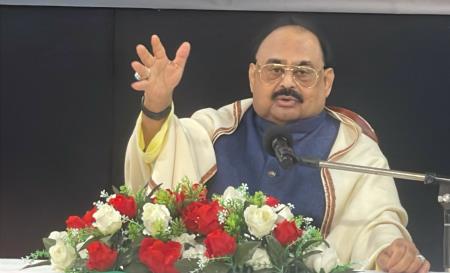
Addressing his 472nd intellectual session on TikTok
September 25, 2026
|
10/18/2026 12:18:40 AM
|
|